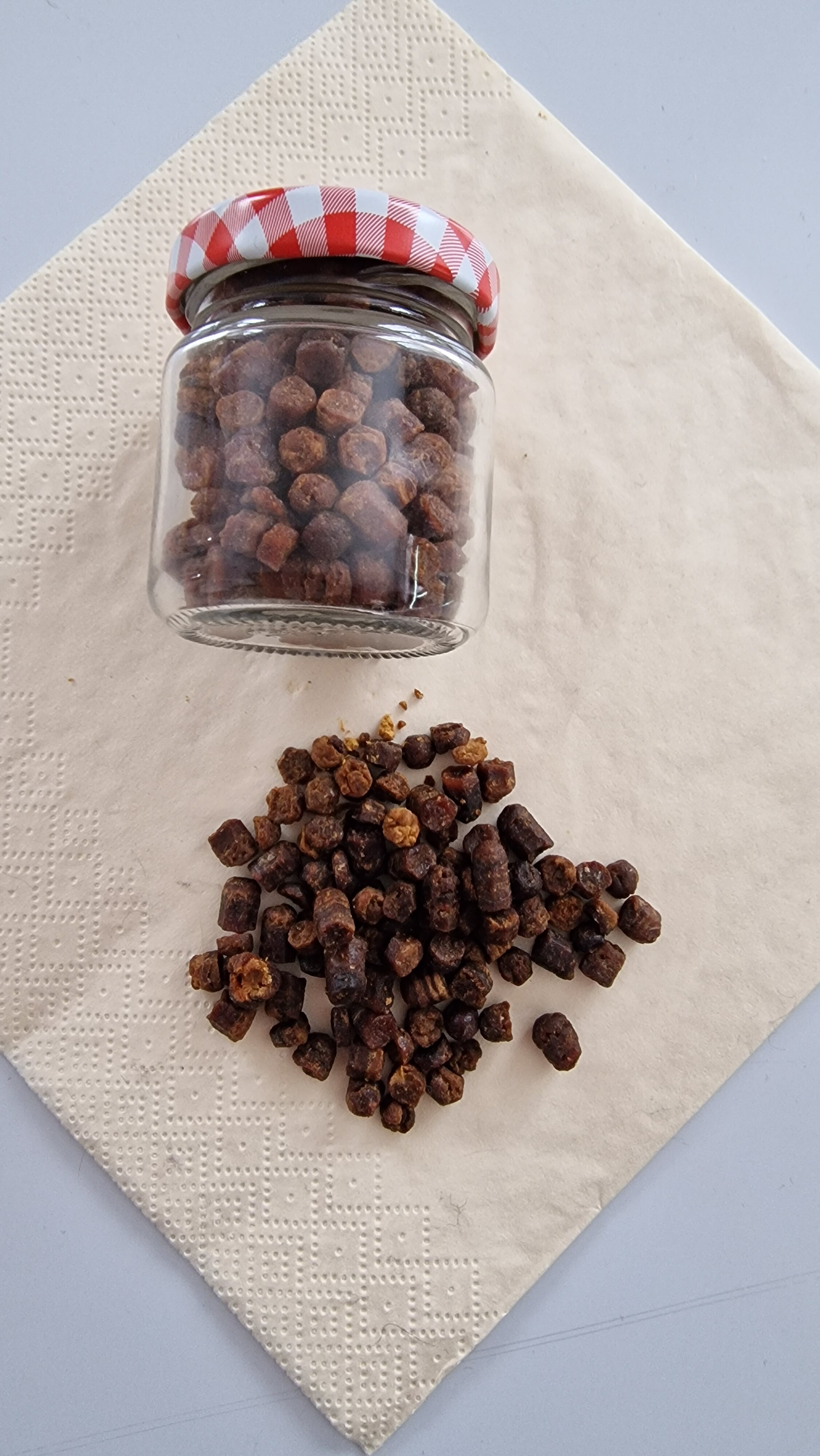
Bee bread is fermented pollen. The bees collect pollen, bring it to their hive, mix it with honey, and ferment it. The protective silicate layer is broken down, and bee bread, or perga in Russian, is produced.

Due to the addition of honey, bee bread contains more sugar than pollen alone. The fermentation process also results in a higher vitamin content.

Bee bread contains vitamins B1 to B12, as well as provitamins A, C, D, E, and K.

It also contains the free fatty acid 10-HDA (also found in royal jelly), a very valuable element for health.

In 1945, the Russian biologist Nikolai Tsitsin reported in the London Sunday Express that more than 90% of all centenarians were beekeepers (184 out of 206 people) who primarily subsisted on bee bread.


Bee bread contains vitamins B1 to B12, as well as provitamins A, C, D, E, and K. Applications of pollen and bee bread/perga include:
Relieving the burden on liver metabolism,
Supporting digestive problems
Prostate problems and male infertility,
Help with dietary errors,
Exhaustion, chronic fatigue, low performance,
Menopause symptoms,
Hemoglobin production,
Reaction time and sports
Recommended intake: 5-8 g daily.

This is a natural remedy, meaning it must be taken over a longer period,
as is the case with other natural remedies.

Source: from the book "The Power of the Bee" by Dr. Thomas Gloger

A book on apitherapy and bee medicine
.jpg "Bee bread / Perga")
.jpg "Preview: Bee bread / Perga")

.jpg "Bee bread / Perga")