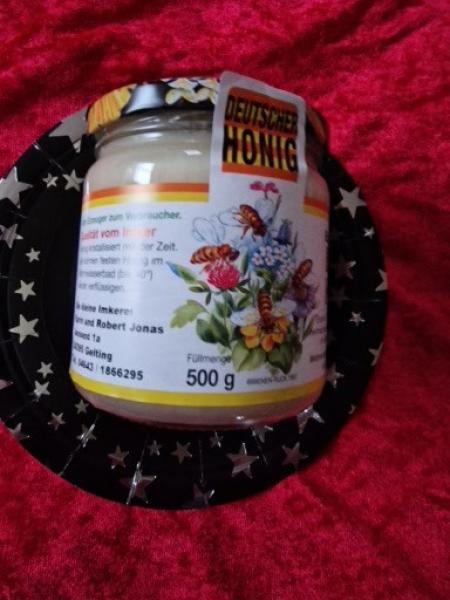
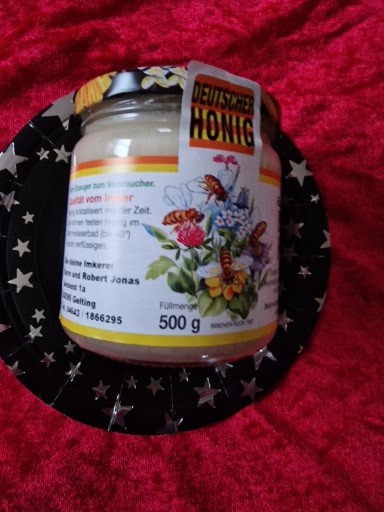
Rapeseed honey from the beekeeper. The rapeseed honey is usually harvested at the end of May or in the first week of June.

We (my wife and I) process it fresh. This means that after extraction (using a honey extractor, i.e., a centrifuge), it is stirred for a few days and then bottled.

Some beekeepers store the honey after harvesting until autumn, when there is more time for bottling. Unfortunately, it then becomes hard—in technical terms, it crystallizes.

The disadvantage of this method is that it must first be liquefied again by heating (often above 30 degrees Celsius, which is not good for the quality) in order to be bottled.

Depending on your preference, we offer the standard 500g jars, but also 250g and 50g jars.

You can also buy linden blossom honey, dandelion honey, clover honey, and more.
Hydroxymethylfurfural (HMF) value. This value indicates something about the quality of honey.

We beekeepers from the German Beekeepers' Association are only allowed a limit of 15 mg/kg. The German Honey Ordinance permits a value of 40 mg/kg, and internationally (mainly from Asia) 80 mg.

Dear consumers, please check the back label. The front label shows a German name and possibly "organic," while the back label indicates origin from EU and non-EU countries. This indicates a value above 80 mg.

The quality and value of the ingredients are negligible. If the consumer says, "I don't care, as long as it's cheap," then that's their decision.

We are happy to sell larger quantities, and of course, a different price applies. For 6 jars of honey, one jar costs €6.50, and for 12 jars, €6.00. Please call: +49 4643 1866295